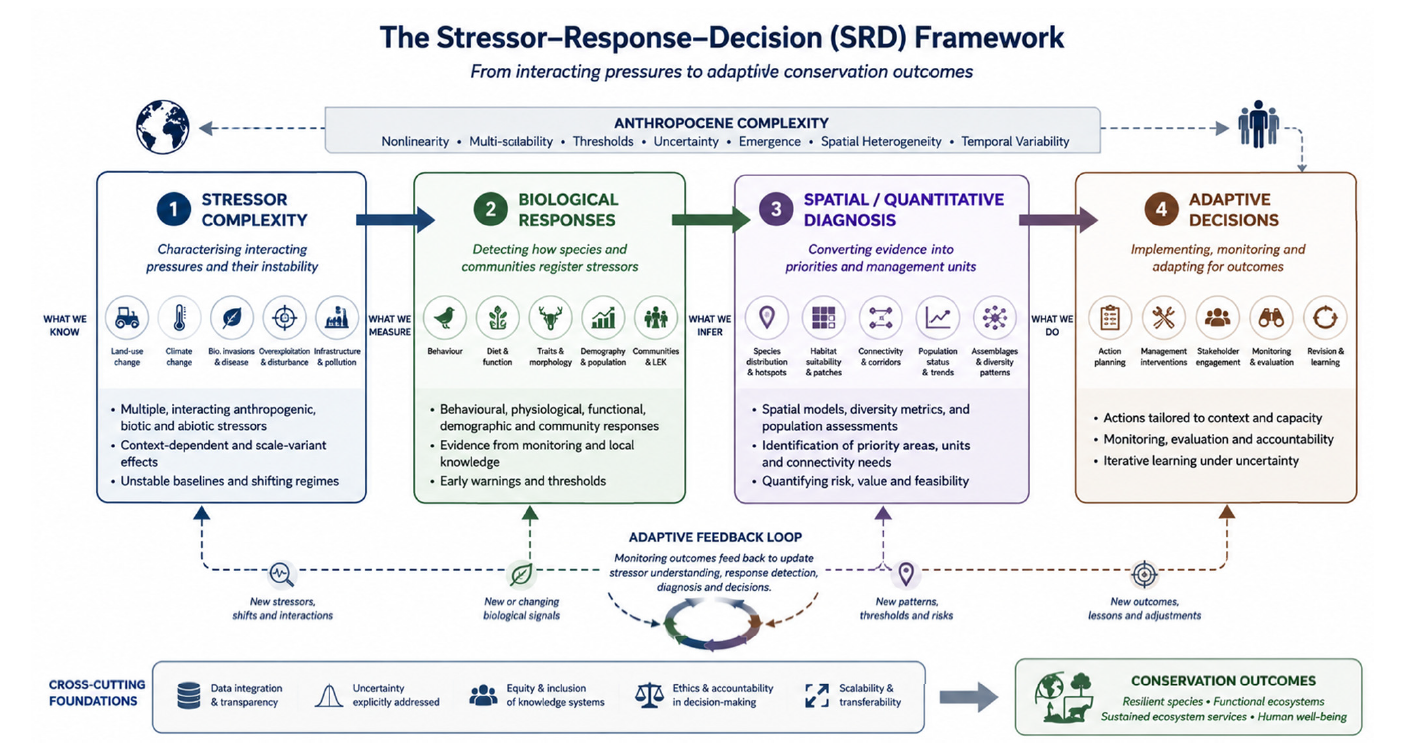
The The Stressor–Response–Decision (SRD) framework for conservation science under Anthropocene complexity conceptualises conservation evidence as a connected circuit linking interacting anthropogenic, biotic, and abiotic pressures to biological responses, spatial or quantitative diagnosis, and adaptive conservation decisions. Stressor characterisation identifies the pressures and interactions structuring ecological systems; response measurement detects how species, populations, communities, and knowledge systems register those pressures; diagnosis translates evidence into hotspots, habitat patches, corridors, population status, assemblage patterns, and management units; and adaptive decisions implement, monitor, evaluate, and revise conservation action. The feedback loop emphasises that monitoring outcomes should update stressor understanding, response detection, diagnostic priorities, and management decisions, maintaining the integrity of the full evidence-to-decision chain.
We use cookies on our website to give you the most relevant experience by remembering your preferences and repeat visits. By clicking "Accept All”, you consent to the use of all the cookies. Select "Cookies Settings" for more information. Cookie settingsAccept AllReject
Privacy & Cookies Policy
Privacy Overview
This website uses cookies to improve your experience while you navigate through the website. Out of these cookies, the cookies that are categorized as necessary are stored on your browser as they are essential for the working of basic functionalities of the website. We also use third-party cookies that help us analyze and understand how you use this website. These cookies will be stored in your browser only with your consent. You also have the option to opt-out of these cookies. But opting out of some of these cookies may have an effect on your browsing experience.