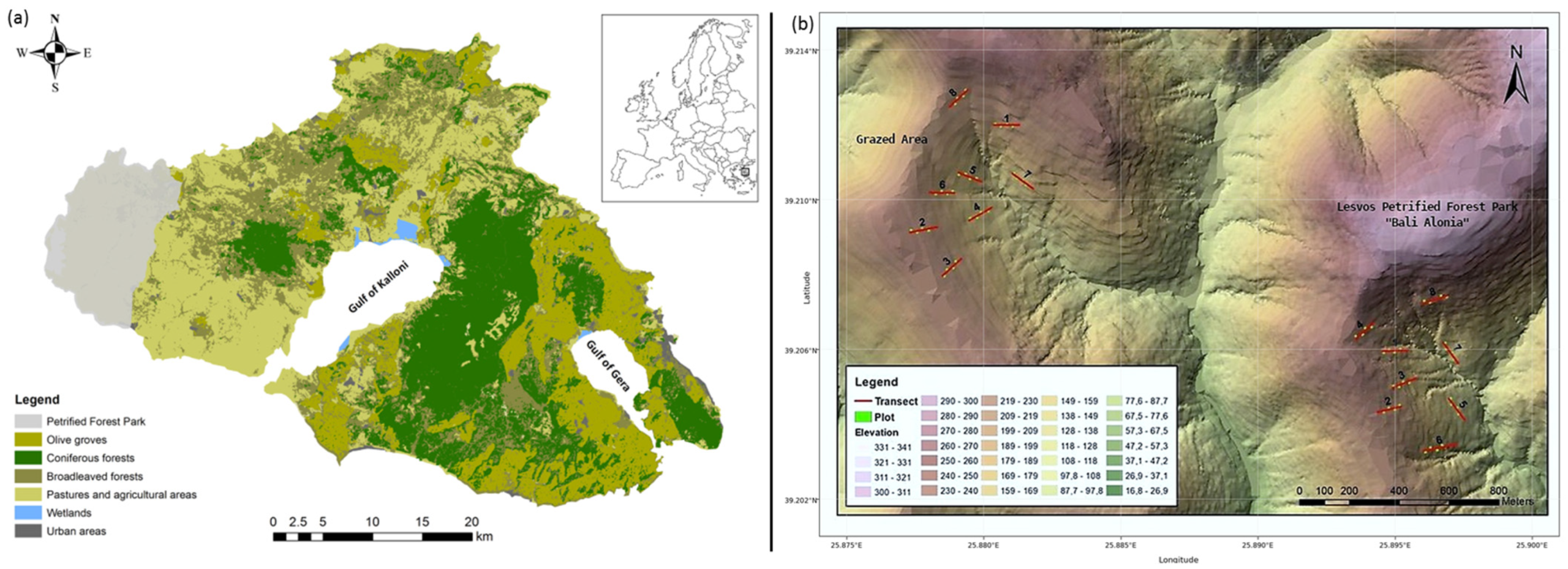
Mediterranean phryganic ecosystems have been shaped for centuries by recurrent herbivory, yet the long-term ecological consequences of grazing cessation remain insufficiently resolved, particularly in protected island landscapes where conservation management often assumes that exclusion promotes recovery. In these drylands, the removal of grazing redirect assembly processes through shifts in dominance, heterogeneity, and functional strategy expression. Here, we use more than three decades-long grazing discontinuity within the Petrified Forest of Lesvos, an insular Mediterranean geopark, to examine how long-term herbivore exclusion reorganizes plant communities across taxonomic and functional dimensions. By integrating floristic inventories, multivariate community analysis, mixed-effects modeling, indicator species analysis, and community-weighted trait approaches, we reconstruct the ecological signature of grazing release in phryganic ecosystems. Long-term exclusion was associated with a broader species pool and a greater representation of protected taxa, while ungrazed communities exhibited lower Shannon and Simpson diversity, greater compositional dispersion, and a marked shift in dominance structure linked to the expansion of Sarcopoterium spinosum. Community differentiation was accompanied by directional reorganization of functional trait structure, with ungrazed plots characterized by taller vegetation and increased leaf and inflorescence length, indicating release from recurrent biomass removal and a transition toward more structurally expansive strategies. These results show that grazing exclusion does not simply enhance biodiversity, but reorganizes Mediterranean plant communities into an alternative ecological state shaped by altered competitive hierarchies, shrub-mediated filtering, and relaxed herbivory. In disturbance-structured island ecosystems, therefore, the ecological outcomes of protection depend not only on whether grazing is removed, but on how strongly community organization has historically depended on its continued presence.
Χρησιμοποιούμε cookies για να προσφέρουμε τη καλύτερη δυνατή εμπειρία στον ιστότοπό μας. Κάνοντας κλικ στο "Αποδοχή όλων", συναινείτε στη χρήση όλων των cookies. Επιλέξτε "Ρυθμίσεις Cookies" για περισσότερες πληροφορίες. Ρυθμίσεις CookiesΑποδοχή ΌλωνΑπόρριψη Όλων
Privacy & Cookies Policy
Επισκόπηση Ιδιωτικότητας
This website uses cookies to improve your experience while you navigate through the website. Out of these cookies, the cookies that are categorized as necessary are stored on your browser as they are essential for the working of basic functionalities of the website. We also use third-party cookies that help us analyze and understand how you use this website. These cookies will be stored in your browser only with your consent. You also have the option to opt-out of these cookies. But opting out of some of these cookies may have an effect on your browsing experience.
Necessary cookies are absolutely essential for the website to function properly. This category only includes cookies that ensures basic functionalities and security features of the website. These cookies do not store any personal information.
Functional cookies help to perform certain functionalities like sharing the content of the website on social media platforms, collect feedbacks, and other third-party features.
Performance cookies are used to understand and analyze the key performance indexes of the website which helps in delivering a better user experience for the visitors.
Analytical cookies are used to understand how visitors interact with the website. These cookies help provide information on metrics the number of visitors, bounce rate, traffic source, etc.
Advertisement cookies are used to provide visitors with relevant ads and marketing campaigns. These cookies track visitors across websites and collect information to provide customized ads.