Christopoulou, A., Lasut-Zmudzka, D., Zikos, A. et al. (2026) Revealing the ecology of Pinus peuce forests in Greece through tree rings forest dynamics and plant diversity. Discover Conservation 3, 31
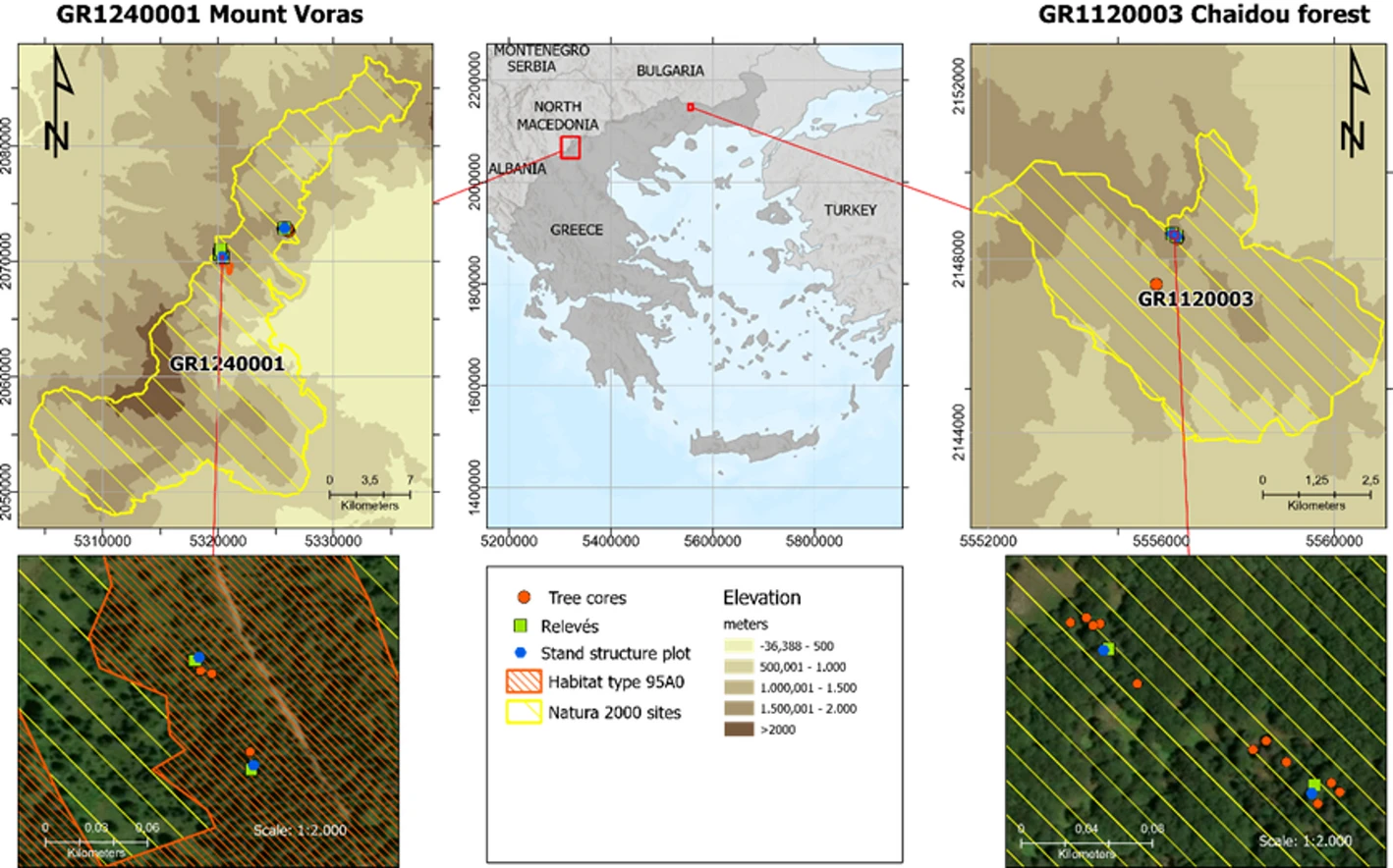
Macedonian pine (Pinus peuce) is a Tertiary relict and Balkan endemic species with a restricted distribution across the peninsula, with Greece forming the southernmost limit of its distribution. At the European level, Macedonian pine forests are recognized as a protected habitat type, forming the High oro-Mediterranean pine forests (95A0), together with Bosnian pine (Pinus heldreichii). In the EU (EU28), habitat type 95A0 is classified as Near Threatened (NT), while in Greece its conservation status is assessed as Inadequate–Bad (U2). Although Bosnian pines have attracted considerable scientific interest—mainly due to the presence of multi-century or even millennia-old trees—information on Pinus peuce forests in Greece, including their age, structure, and plant diversity, remains scarce. This is largely attributed to the limited accessibility of these forests, as most known stands occur near the national borders and/or on steep ravines and slopes. The aim of the current study was to investigate key aspects of Pinus peuce forest stands in Greece by providing data on their age, growth pattern, structure, and plant diversity, as well as to offer insights into their future trajectories and potential conservation needs, particularly under the light of ongoing climate and land-use change.